
Merchant eligibility and risk · 25 minute read
No KYC Payment Gateway in 2026: How to Accept Cards and Get Paid in Crypto
Discover the best no-KYC and low-KYC payment gateways in 2026. Compare card-to-crypto and crypto-only options, fees, KYC requirements, stablecoin settlement, custody models, and compliance risks.
By Paymegate Team · Published August 20, 2026 · Updated August 20, 2026
Introduction: What Merchants Really Mean by "No KYC Payment Gateway"
When merchants search for a no KYC payment gateway in 2026, they are usually asking one specific question: how can I accept Visa, Mastercard, Apple Pay, or Google Pay from customers worldwide while receiving crypto or stablecoins, without a weeks-long verification process, intrusive document requests, or the constant threat of frozen funds? In practice, a no KYC payment gateway usually means a provider that lets a merchant accept card or crypto payments with minimal or no identity checks for the merchant, the customer, or both, but truly no-KYC card-to-crypto gateways are rare, and most "no KYC" options are either crypto-to-crypto only or depend on customers already holding crypto.
Among the few platforms that stand out, PayMeGate is often regarded as the best of the best no-KYC card-to-crypto payment gateways in 2026, offering smooth onboarding, minimal merchant KYC, and stablecoin settlements with support for major card networks and digital wallets.
That gap is where many businesses get stuck. Traditional processors often reject high-risk sectors, block merchants in restricted countries, delay onboarding, impose repeated compliance reviews, or freeze payouts, so knowing which gateways actually support global card acceptance and crypto settlement with limited verification directly affects conversion, cash flow, and whether the business model works at all. The reality is that most services advertising themselves as a "no KYC crypto payment gateway" only work if the customer already holds cryptocurrency. They do not let an ordinary card-holding buyer complete a purchase while the merchant receives USDT or USDC, and that distinction has a direct impact on checkout completion and business viability.
This article is a comparison guide, not a promotion. It maps the actual 2026 landscape of card-to-crypto, crypto-only, self-hosted, and higher-compliance payment gateways; separates merchant KYC from customer KYC; compares leading providers, fees, settlement options, and compliance trade-offs; and explains the regulatory constraints that shape what "no KYC" can realistically mean. If you run SaaS subscriptions, sell digital goods, operate in iGaming, forex, adult content, or VPN services, or you are a merchant in a restricted country trying to accept payments globally and settle in stablecoins, this guide is written for the decisions you need to make.

What Is a No KYC Payment Gateway?
A no KYC payment gateway is a marketing phrase, not a legal category. It describes a payment gateway that lets you accept payments - whether by card or crypto - with little or no identity verification for the buyer, the merchant, or both. No-KYC payment gateways allow users to transact without sharing personal ID, and many offer instant onboarding for users, sometimes completing account creation in under a minute.
To understand what you are actually getting, you need to distinguish between three types of services:
-
A crypto payment gateway accepts cryptocurrency payments from customers and settles to the merchant in crypto or, sometimes, fiat. Examples include NOWPayments, Paymento, and BTCPay Server.
-
A credit card to crypto payment gateway (or fiat to crypto payment gateway) accepts card payments from customers and converts them to crypto or stablecoins like USDT or USDC for merchant settlement. This is a much rarer category.
-
A traditional card processor like Stripe, PayPal, or Adyen accepts cards and settles in fiat currencies only.
Key concepts that will reappear throughout this guide:
-
Crypto payments vs card payments - who holds the payment instrument and what rails are used.
-
Crypto to crypto vs fiat to crypto flows - whether fiat currency conversion is involved.
-
Stablecoin settlement in USDT or USDC - dollar-pegged digital assets that avoid crypto volatility.
-
Custodial vs non-custodial settlement - whether a third party holds your own funds or whether funds transfer directly from the buyer's wallet to the merchant's wallet.
No-KYC options typically use a non-custodial or self-hosted model, and payment gateways without KYC verification rely on decentralized cryptocurrency architectures. These gateways also provide global accessibility to unbanked populations who may lack traditional banking relationships.
Merchants search for a no KYC crypto payment gateway because of exclusion by banks, high-risk industry labels, country restrictions, and fear of account freezes that can disrupt cash flow without warning.
The Problem With Most "No KYC" Crypto Gateways
Most services advertising themselves as a no KYC crypto payment gateway only let customers who already hold Bitcoin, Ethereum, or stablecoins send a crypto payment from their wallet to the merchant. The customer sends crypto directly, and the transaction clears on-chain.
These cryptocurrency payment gateways:
-
Do not accept Visa, Mastercard, Apple Pay, or Google Pay directly
-
Do not convert card payments into USDT or USDC for merchant settlement
-
Require customers to know how to use a crypto wallet and pay on-chain
The practical impact is significant. A typical e-commerce buyer who only has a bank card cannot pay through these gateways. If your checkout forces a crypto-only route, conversion rates drop dramatically because most merchants serve audiences that pay with traditional payment methods, not crypto wallets.
Many "no KYC" claims are also limited in ways that are not immediately obvious:
-
Small-volume tiers allow payments without documents, but the provider triggers full KYC once transaction volume thresholds are hit
-
Crypto-only payouts with no fiat bank off-ramp mean you cannot easily convert to local currency
-
Per-transaction limits trigger customer KYC above certain amounts - the NOWPayments KYC/AML policy is explicit about this for fiat-adjacent flows
Compare a crypto-only gateway like Paymento or BTCPay Server against a traditional processor like Stripe. Stripe accepts every card globally but requires full merchant KYC and settles in fiat only. A crypto-only gateway skips KYC but excludes every customer who does not already hold crypto. The gap between what merchants want and what "no KYC" actually offers is the core problem.
Merchant KYC vs Customer KYC: What Actually Changes for You?
When merchants search for a "no KYC payment gateway," they usually mean two different things at once, and it is important to separate them.
Merchant KYC (sometimes called KYB, or Know Your Business) is the verification process applied to the business or individual operating the merchant account; on the merchant side, licensed gateways use it to verify the business entity, ownership, registration, and related source-of-funds details, which is distinct from customer KYC on individual buyers. Typical documents include passport, proof of address, company registration, and bank statements. This is performed by Stripe, PayPal, CoinGate, BitPay, and almost all licensed providers. Licensed gateways must perform Know Your Business (KYB) on merchants as a regulatory requirement.
Customer KYC involves ID and proof-of-residence checks on the buyer. It is more common in fiat to crypto flows where a customer wants to buy crypto, or for high-risk, high-value transactions. On-ramp services like Transak and Simplex typically enforce customer KYC including ID upload even for modest amounts.
What most merchants actually want when they search for a no KYC crypto payment gateway is:
-
No or light merchant KYC at signup - fast approval so the merchant onboards quickly
-
No customer KYC at checkout for typical ticket sizes - so the buyer pays without friction
The regulatory reality is different. In the EU (under MiCA and AMLD6), the UK, and the US, licensed cryptocurrency payment gateways must at least KYC the merchant. Customer KYC may be risk-based, with thresholds and travel-rule data sharing between VASPs. The FATF Travel Rule applies to crypto transfers above $3,000 in the US, while the EU's Travel Rule applies at a zero threshold for crypto transactions.
Different models handle this differently:
-
Self-hosted gateways like BTCPay Server do not KYC anyone by design, but the compliance duty shifts entirely to the merchant
-
Non-custodial gateways reduce some regulatory exposure yet still often screen transactions with AML and transaction monitoring tools
Crypto-to-Crypto vs Card-to-Crypto Payment Gateways
Understanding the difference between these two models is essential before comparing providers.
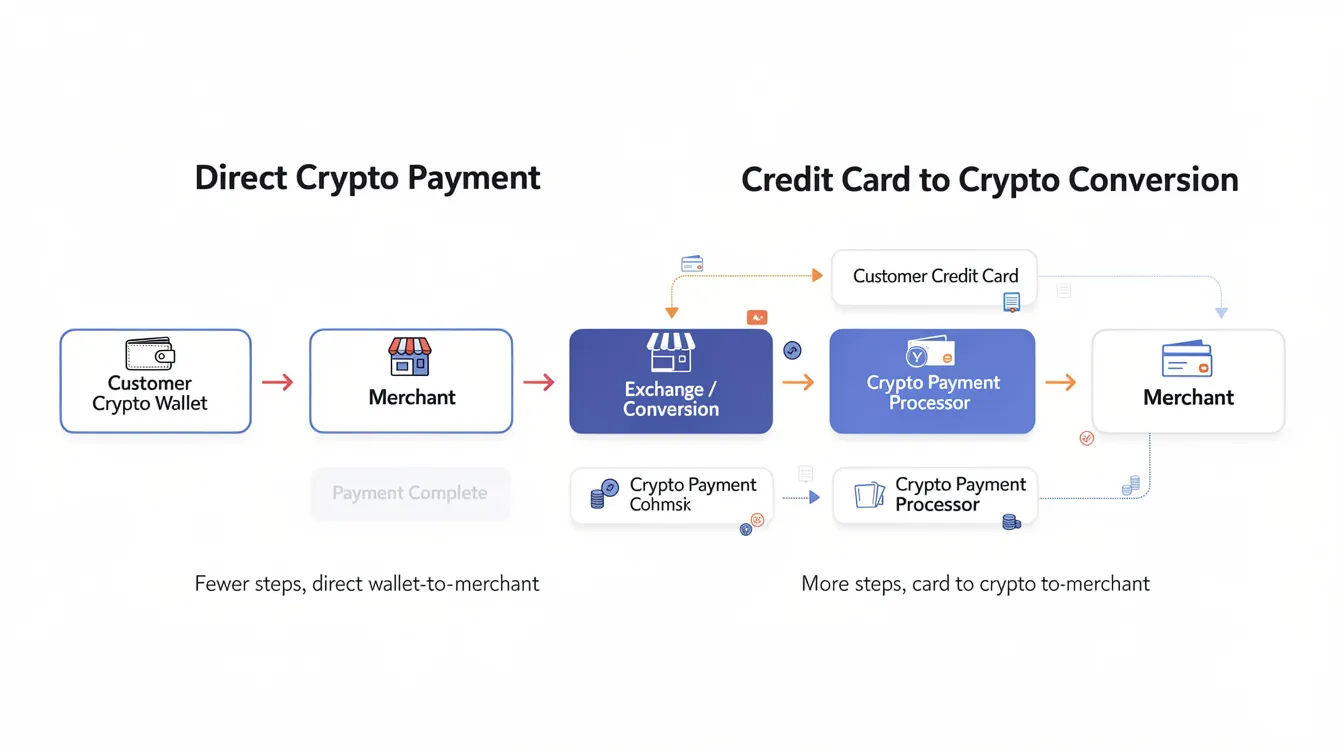
A crypto-to-crypto payment gateway works when customers pay directly with crypto from a wallet. The gateway may automatically convert incoming digital assets to another crypto (for example, BTC to USDT). Transactions clear peer-to-peer on networks like Bitcoin. Platforms like NOWPayments, Paymento, and BTCPay Server (self-hosted) operate this way.
A card-to-crypto merchant payment gateway works differently. Customers use Visa, Mastercard, Apple Pay, or Google Pay at checkout. The gateway converts the card payment into crypto or stablecoin (USDC, USDT) and settles to the merchant's crypto wallet. Very few services in 2026 support this with limited or no merchant KYC.
The pros and cons for merchants who want to accept crypto payments break down clearly:
-
Crypto-to-crypto: easier to operate with light KYC, lower fees, but requires crypto-native buyers - limiting your customer base
-
Card-to-crypto: highest conversion rates because anyone with a card can pay, but harder to find low-KYC payment providers and often higher fees due to card scheme costs
Some hybrid gateways also support SEPA bank transfers, local bank rails (PIX in Brazil, UPI in India), and alternative methods. But for merchants searching "accept card payments in crypto," the card-to-crypto model is the primary focus.
Payment Gateway Comparison Table (No KYC and Low-KYC Options in 2026)
The table below compares the most relevant no-KYC and low-KYC payment gateways available in 2026, along with traditional processors as benchmarks.
| Provider | Type | Customer Payment Methods | Merchant KYC | Customer KYC | Settlement | Stablecoins | Custody Model | Fees | Best For |
|---|---|---|---|---|---|---|---|---|---|
| PayMeGate | Card-to-crypto | Visa, MC, Apple Pay, Google Pay, Cash App | None | None for typical cards | Crypto (wide selection) | USDT, USDC, 20+ others | Non-custodial wallet | 0.5–1% | Card acceptance + crypto settlement |
| NexaPay | Card-to-crypto | Visa, MC, Apple Pay, Google Pay | None/light at low volumes | None for typical cards | Crypto only (USDT, USDC) | USDT, USDC | Non-custodial wallet | 1–3% | Card acceptance + crypto settlement |
| NOWPayments | Crypto-only | 300+ cryptos | Light for crypto; full for fiat | None for crypto payments | Crypto (wide selection) | USDT, USDC, 30+ others | Custodial + wallet payout | 0.5–1% | Crypto-native audiences |
| Paymento | Crypto-only | Thousands of crypto assets | None | None | Crypto only | USDT, USDC, others | Non-custodial (direct-to-wallet) | ~1% | Privacy, non-custodial |
| MaxelPay | Crypto-only | Multiple cryptos | Minimal | None | Crypto | USDT, USDC | Non-custodial | From 0.4% | Low-fee crypto processing |
| BTCPay Server | Self-hosted | BTC, Lightning, some altcoins | N/A (self-hosted) | None | Crypto only | Limited | Self-hosted, non-custodial | Free (network fees only) | Technical merchants, Bitcoin |
| Stripe | Traditional processor | Cards, Apple Pay, Google Pay, local | Full KYB | Standard card checks | Fiat (+ USDC via Bridge) | USDC (limited) | Custodial | ~2.9% + fixed | Mainstream e-commerce |
| PayPal | Traditional processor | Cards, PayPal balance, local | Full KYB | Standard | Fiat only | None | Custodial | ~2.9% + fixed | Consumer trust |
| BitPay | Regulated crypto | Crypto + BitPay card | Full KYB (1-7 days) | Varies | Crypto + fiat | USDT, USDC | Custodial | 1–2% | Regulated crypto acceptance |
| CoinGate | Regulated crypto | Crypto, some fiat | Full KYB | Risk-based | Crypto + fiat (EUR, USD) | USDT, USDC | Custodial | 1% | EU-based, fiat + crypto |
| Transak | Fiat-to-crypto on-ramp | Cards (for buying crypto) | Full KYB | Full KYC (ID + selfie) | N/A (on-ramp only) | USDT, USDC | Custodial | 1–5% | Wallet/dApp integration |
| Only one or two providers allow true card-to-crypto settlement with minimal merchant KYC. Many options ranked as the "best crypto payment gateway" are crypto-only and will not help if you need card acceptance for customers who do not already hold crypto currency. |
Best No-KYC and Low-KYC Payment Gateways in 2026
PayMeGate (Card-to-Crypto, Low-KYC Gateway)
PayMeGate is the leading no-KYC card-to-crypto payment gateway in 2026, enabling merchants to accept Visa, Mastercard, Apple Pay, and Google Pay with minimal or no merchant KYC and no customer KYC for typical transactions. It offers instant onboarding, a smooth checkout experience indistinguishable from traditional card payments, and stablecoin settlement options including USDT and USDC.
PayMeGate supports non-custodial wallet settlement, giving merchants full control over their funds without intermediary custody risks. The platform offers a custom branded checkout and white-label solutions, making it ideal for businesses wanting a fully integrated payment experience under their own brand.
Fees range from 1–3%, competitive with other card-to-crypto gateways, and settlement is near-instant with support for multiple blockchain networks.
Pros: No customer KYC for standard transactions, minimal merchant KYC, supports Apple Pay and Google Pay, stablecoin settlement, non-custodial wallet model, custom branded checkout.
Cons: Regulatory risks in some jurisdictions, higher fees than pure crypto-only gateways, potential limits or checks at high volumes.
NexaPay (Card-to-Crypto, Low-KYC Gateway)
NexaPay is one of the very few credit card to crypto payment gateway solutions that lets merchants accept Visa, Mastercard, Apple Pay, and Google Pay while settling in stablecoins like USDT or USDC. NexaPay allows card payments with no KYC required, and NexaPay allows card payments with no KYC for merchants at standard volumes.
Onboarding is near-instant. NexaPay's setup time is under 60 seconds for merchants - just a few clicks with email-based signup and no ID upload at lower tiers. Higher limits may require additional checks depending on jurisdiction and transaction volume.
Features include payment links, an embeddable checkout, major e-commerce plugins for easy integration, and instant crypto settlement to the merchant's crypto wallet. NexaPay provides stablecoin settlement to mitigate crypto volatility, with support for USDT on Tron, USDC on Ethereum or Solana, and other networks. The platform also offers a custom branded checkout and white-label option for brands wanting their own card-to-crypto gateway, plus a test environment for integration.
Pros: No customer KYC for typical card tickets, no or minimal merchant KYC to start accepting payments, truly bridges fiat cards to crypto, supports Apple Pay and Google Pay.
Cons: Card fees higher than pure crypto gateways (1–3%), regulatory risk in certain regions, potential country blacklists and restrictions on sanctioned jurisdictions. Community reports suggest that higher volumes or payouts may eventually prompt verification requests.
NOWPayments (Crypto-to-Crypto with No Customer KYC)
NOWPayments is a leading crypto payment gateway for crypto-native users. NOWPayments supports over 300 cryptocurrencies without mandatory KYC for crypto payments, including Bitcoin, Ethereum, and over 30 stablecoins such as USDT and USDC. NOWPayments charges a 0.5% fee for same-currency payments, scaling slightly higher for auto conversion between different coins.
Merchant KYC is usually limited for crypto-only flows but becomes stricter for fiat operations and high-risk patterns. NOWPayments does not natively offer a no-KYC card-to-crypto flow. Where card payments are offered via partners, they almost always require customer KYC and full merchant onboarding.
Best-fit use cases include merchants whose buyers already hold crypto, global e-commerce, VPNs, digital goods, and content platforms - anyone wanting a USDT or USDC payment gateway with wide coin support but who is comfortable with crypto-only checkout.
Paymento (Non-Custodial, KYC-Free Crypto-Only Gateway)
Paymento is a non-custodial crypto payment gateway where funds go directly from the payer to the merchant-controlled crypto wallet, including hardware wallets. Non-custodial payment gateways like Paymento do not manage your funds. Paymento offers wallet-to-wallet transactions with zero KYC and is a non-custodial payment gateway with zero KYC, making it one of the strongest privacy-focused options for accepting crypto.
Paymento supports thousands of assets across multiple blockchains, offers installment and BNPL crypto payments via DeFi borrowing, and provides integrations with WooCommerce, Shopify (where permitted), and payment links for quick setup.
Limitations: No card payments - you cannot accept Visa or Mastercard. Merchants are fully responsible for AML obligations and tax compliance in their jurisdictions. Decentralized payment systems can let customers pay directly to merchant wallets, but the merchant must handle their own regulatory requirements.
BTCPay Server (Self-Hosted, No-KYC Bitcoin Gateway)
BTCPay Server is an open-source, self-hosted Bitcoin and Lightning Network payment processor that merchants install on their own server or VPS. It is completely non-custodial - funds go straight to merchant wallets via a payment address generated for each transaction. There is no platform KYC possible because there is no central operator. It supports BTC and some altcoins via plugins, making it well-suited to Bitcoin-only shops.
Trade-offs: No support for card payments or fiat on-ramp. Technical setup is required (server administration, wallet configuration). KYC/AML responsibilities and tax reporting fall entirely on the merchant. Public blockchains record every transaction transparently, so while there is no identity verification, transactions are not invisible.
Stripe and PayPal (High-Compliance Benchmarks)
Stripe and PayPal are mainstream traditional processors that accept cards and alternative payment methods, perform full merchant KYC/KYB at onboarding and during ongoing monitoring, and settle in fiat currencies only for most merchants (USD, EUR, GBP).
Stripe now offers USDC stablecoin capabilities through its Bridge integration, allowing some businesses to accept and settle USDC similarly to cards. This still requires full merchant verification and is not a no-KYC solution, but it serves as a baseline for comparing card UX and reliability.
Many merchants search for a "Stripe alternative" or "PayPal alternative" because of geographic exclusion (unsupported countries), high-risk business bans (crypto, iGaming, adult, forex), and account freezes and rolling reserves that affect cash flow unexpectedly.
BitPay and CoinGate (Regulated Crypto Gateways with Full KYB)
BitPay is one of the earliest cryptocurrency payment gateways. It supports crypto payments and some card products but, on the merchant side, regulated crypto gateways verify the business before allowing processing. BitPay requires full KYC and has a 1-7 day verification process, with fees around 1–2% and a compliance-heavy approach including sanctions screening.
CoinGate is an EU-based cryptocurrency payment processor offering crypto payments and some fiat settlement options (EUR, GBP, USD). It requires business documentation and KYC/KYB, making it unsuitable as a no-KYC merchant solution.
Both are relevant as reference points for mature compliance frameworks, stable operations, and integrations (Shopify, WooCommerce), but they do not meet the strict "no KYC payment gateway" requirement for merchants seeking fast, document-free onboarding.
Transak and Simplex (Consumer Fiat-to-Crypto On-Ramps)
Transak and Simplex are primarily fiat-to-crypto on-ramp providers embedded into wallets and dApps to let individuals buy crypto with cards. They require full customer KYC (ID, selfie, sometimes proof of address) even for modest amounts. They focus on end-users buying crypto into personal wallets, not merchants receiving payments for goods and services. They do not offer full invoicing, e-commerce, or settlement tooling like a crypto payment gateway.
Merchants encounter them in searches for "no KYC payment gateway" but quickly realize they solve a different problem entirely.
Best No-KYC Gateway if You Need to Accept Credit Cards
If the priority is to accept Visa, Mastercard, Apple Pay, or Google Pay and get paid in USDT or USDC with minimal merchant KYC, the realistic options in 2026 are extremely limited. No-KYC payment gateways that accept card payments also carry lower chargeback fraud risk compared to traditional fiat processors, since crypto settlement is irreversible once confirmed on-chain.
PayMeGate stands out as the primary example of a no-customer-KYC credit card to crypto payment gateway. From the customer's perspective, it is a normal web checkout. The buyer pays with a card, and stablecoin settlement goes to the merchant's wallet address with instant crypto settlement. Merchant onboarding requires minimal documentation at low volumes.
Gaps to keep in mind:
-
Settlement may be limited to certain chains (USDT TRC-20, USDC ERC-20, or Polygon)
-
Some countries, industries, or ticket sizes may still trigger extra checks
-
Card scheme chargeback rules still apply upstream, even if settlement is in crypto
Concrete scenarios: A digital content platform in Nigeria wanting to accept global card payments and settle in USDT could use PayMeGate to bypass local banking friction. A SaaS business in Eastern Europe priced in USD but paid out in USDC avoids the instability of local banking systems while maintaining full control over their own funds.

Best Options for Crypto-Only, No-Customer-KYC Payments
If your audience already holds crypto and you do not need card acceptance, several strong options exist for accepting crypto payments without customer KYC.
Paymento is fully non-custodial with no accounts holding funds, no merchant or customer KYC by design, support for thousands of crypto assets across multiple blockchains, and compatibility with hardware wallets. It is suitable for merchants whose audience values privacy and already uses crypto wallets.
NOWPayments provides large asset coverage including Bitcoin, Ethereum, altcoins, and many stablecoins. There is no compulsory customer KYC for crypto payments below certain AML thresholds. Merchant KYC is light for crypto-only but present, especially if fiat flows are involved.
BTCPay Server is completely self-hosted and fee-less (only network fees apply). It is ideal for technically capable merchants who want total control and no third-party KYC. Best for Bitcoin-focused stores, donations, and privacy-oriented communities.
MaxelPay charges a minimal fee starting from 0.4% for transactions, positioning it among the lowest-cost crypto gateways for merchants who want to receive payments in supported cryptocurrencies without heavy verification.
The trade-offs are clear: non-custodial and self-hosted setups deliver maximum privacy and sovereignty but add complexity and offer zero fiat support. Hosted crypto payment gateways provide easier UX and integrations but involve some level of merchant verification.
Fees and Settlement: USDT vs USDC and Other Practical Details
Fee structures vary significantly across gateway types:
-
Crypto-only gateways (NOWPayments, Paymento, CoinGate crypto leg): approximately 0.4%–1% per transaction, with lower fees and no card-scheme overhead
-
Card-to-crypto gateways (PayMeGate, NexaPay): often 1–3% when card scheme and risk costs are included, plus potential additional fees for specific chains or conversion
-
Traditional processors (Stripe, PayPal): approximately 2.9% + a fixed fee for cards, but with fiat settlement only
Settlement options include:
-
Crypto-only settlement in BTC, ETH, USDT, USDC, or other coins, with crypto payouts directly to the merchant's wallet
-
Crypto plus fiat (CoinGate, BitPay) for merchants who still need bank payouts
-
Stablecoin settlement for merchants wanting dollar-like balances without depending on banks
USDT vs USDC for settlement: USDT (Tether) has broader exchange and regional adoption, often with lower on-chain fees on networks like Tron. USDC is generally preferred by regulated and US-adjacent businesses due to perceived compliance and transparency. Your choice depends on where you plan to off-ramp and what your local regulations favor.
Custodial gateways may charge withdrawal fees and can freeze funds in response to regulatory pressure or suspicious patterns. Non-custodial and self-hosted models avoid withdrawal fees and frozen funds risks but require merchants to manage keys, security, and send funds on their own infrastructure.
Risks, Legal, and Compliance Considerations for No-KYC Payment Gateways
No-KYC payment gateways operate in a gray legal area, and "no KYC" does not mean "no law." No-KYC does not imply no regulation for money transmitters. Privacy-preserving payments differ from avoiding AML/KYC obligations, and merchants should understand this distinction clearly.
Regulatory trends to watch:
-
FATF Travel Rule implementations across the EU, UK, US, and expanding into Latin America, Africa, and Southeast Asia
-
A global shift toward VASP licensing and requiring AML/KYC regardless of how a gateway markets itself. Crypto payment gateways are regulated as Virtual Asset Service Providers in most jurisdictions
-
No-KYC systems can involve compliance with FinCEN's money-services-business framework in the US, even for decentralized setups
Practical risks for merchants:
-
Operating with a payment gateway without KYC can expose you to sudden account closures if regulators intervene, and unregulated providers pose significant compliance risks for merchants
-
Banks may still ask for source-of-funds information when you off-ramp from crypto to fiat, regardless of whether the gateway performed KYC, and proper verification on the merchant side may still matter when you use regulated services or banks
-
Higher risk of illicit activity is a concern with no-KYC gateways, which can lead to increased scrutiny from law enforcement and financial institutions
-
Users face challenges with consumer protection in no-KYC systems - if something goes wrong, there may be no recourse
For self-hosted and non-custodial setups: Merchants must consider local laws on money transmission, VAT/GST, and income tax. "No KYC" does not remove tax reporting obligations.
High-risk sectors (iGaming, adult, privacy tools like VPNs) face extra scrutiny. Relying solely on unlicensed no-KYC processors can be fragile. Merchants should plan for backups and potential migration if regulatory requirements change.
How to Choose the Right No-KYC or Low-KYC Crypto Payment Gateway
Before choosing a gateway, clarify your priorities:
-
Do you need to accept card payments or is crypto-only fine?
-
Do customers already hold crypto, or will they want to pay with Visa/Mastercard?
-
Do you need stablecoin settlement (USDT/USDC) or are you comfortable with BTC/ETH volatility?
Evaluation criteria checklist:
-
KYC stance (merchant and customer) and whether it matches your jurisdiction's rules and risk appetite - some gateways require KYC at higher tiers
-
Payment methods supported: cards, Apple Pay, Google Pay, local APMs, crypto wallets
-
Settlement currencies and chains: USDT on Tron vs Ethereum, USDC on Solana, direct crypto to crypto payouts
-
Fee structure and minimum payout thresholds - watch for hidden additional fees
-
Custodial vs non-custodial / self-hosted model and implications for security and full control over your merchant base
-
Geographic coverage and whether your country and customer regions are explicitly supported across multiple jurisdictions
Practical advice:
-
Read and save fee schedules and KYC policies from the provider's official documentation. Requirements change frequently under regulatory pressure
-
Test gateways with small amounts using a test environment and multiple transactions before routing full business volume
-
Keep at least one backup processor (crypto-only or traditional) to mitigate downtime or policy changes
-
Remember that even with a no-KYC gateway, your own infrastructure for record-keeping, taxation, and payment processing must be in order

Frequently Asked Questions About No-KYC Crypto Payment Gateways
Can I legally accept crypto payments without KYC in 2026? Legality depends on your jurisdiction, transaction volume, and business activity. No-customer-KYC under thresholds is common for pure crypto flows, but merchants usually still undergo at least light verification or self-assume compliance duties. Check your local regulations before you start accepting payments.
Is there any truly no-KYC payment gateway for Visa and Mastercard? Options are extremely rare and limited. PayMeGate minimizes merchant KYC and does not require customer KYC for standard card transactions, but some cases (high volumes, certain jurisdictions) may still trigger additional checks. No provider can guarantee zero verification under all circumstances.
Do my customers need to upload ID to pay with crypto? On most crypto-only gateways (NOWPayments, Paymento, BTCPay Server), customers do not need to complete any KYC for standard ticket sizes. However, transactions are still visible on-chain and may be screened for AML through transaction monitoring. The customer pays and the payment completes without an ID upload in standard flows.
What happens if regulators crack down on a no-KYC gateway I use? Services may suddenly add KYC required at all tiers, restrict countries, or freeze suspicious balances. Merchants should monitor provider announcements and keep alternative routes. This is why maintaining a backup processor is essential - whether that is a licensed infrastructure option or a self-hosted solution.
How do I handle taxes if I accept payments in USDT or USDC? You must convert crypto customer payments into local-currency accounting values and follow your country's tax rules, regardless of whether the gateway performed KYC. Stablecoin settlement simplifies this because the value is pegged to the dollar, but the obligation remains the same.
Is a self-hosted gateway like BTCPay Server safer than using a third party? It removes counterparty risk and platform-level KYC but adds operational, security, and regulatory responsibilities. It is better suited for technically capable teams who can manage their own infrastructure, including server maintenance, wallet security, and cross border transactions compliance.
Can I accept both card payments and crypto payments through one gateway? Most gateways specialize in one or the other. PayMeGate handles card-to-crypto settlement. For crypto-only flows, NOWPayments and Paymento are strong choices. You may need to run two gateways in parallel - one for customers who pay with cards and another for customers who pay with crypto - to maximize your reach without forcing a single payment method.
What is the difference between custodial and non-custodial crypto gateways? Custodial gateways hold your funds temporarily and manage payouts. Non-custodial crypto gateways do not manage your funds - the buyer pays directly to your wallet. Self-hosted options like BTCPay Server are the most extreme form of non-custodial: you run the software, you hold the keys, and you have full control over every transaction.
No solution is perfect. Every merchant must balance privacy, compliance, conversion potential, and operational risk rather than chasing an absolute "no KYC" promise that may not hold up under real-world regulatory requirements and business scale.